
 PHTAYA
 Sports
 Fishing
 Live Casino
 Lottery
 PVP
PVP Slots
Slots Promotion
 News
News
Poker Games
Poker games offer a captivating balance of strategy, psychology, and unpredictable outcomes that keep players engaged hand after hand. At PHTAYA, every session brings an opportunity to test your wits, read your rivals, and refine the art of the bluff.
The playbook: Hidden truths about poker games strategy

Hidden truths about poker games strategy
Poker games encompass a family of card games where players wager on the strength of their hand compared to others.
While many variations exist, the core objective usually involves forming the best possible hand according to established rankings or convincing opponents to fold theirs. It is a game celebrated for its strategic depth and psychological battles.
At PHTAYA, we offer a selection of popular poker, providing a secure and fair environment for you to test your skills. Whether you prefer the community cards of Texas Hold’em or other exciting formats, our platform uses certified RNGs for digital games and professional dealers for live experiences.
The complete guide to poker games’ laws and play
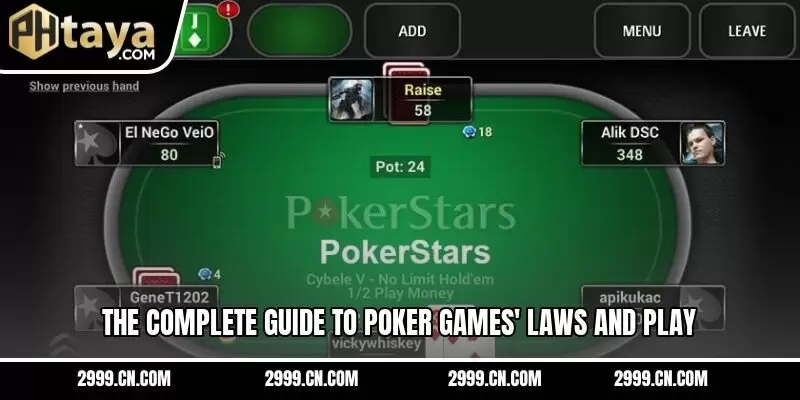
The complete guide to poker games’ laws and play
While specific rules vary between different poker games, certain fundamental principles apply across most formats available at PHTAYA. Mastering these basics is crucial before diving into advanced strategies. These are the foundational elements of most poker.
The objective and basic gameplay
The ultimate goal in most poker games is to win the “pot,” which contains all the bets placed during a hand.
You achieve this either by having the best-ranking hand at the “showdown” (when remaining players reveal their cards) or by betting strategically to make all other players fold before the showdown. Gameplay typically proceeds in rounds, involving dealing cards and placing bets.
Standard poker hand rankings
The hierarchy of hands is crucial. Memorizing this ranking is essential for playing poker. From strongest to weakest:
- Royal Flush: A, K, Q, J, 10, all of the same suit. The unbeatable hand.
- Straight Flush: Five cards in sequence, all of the same suit (e.g., 9, 8, 7, 6, 5 of Hearts).
- Four of a Kind: Four cards of the same rank (e.g., four Jacks).
- Full House: Three cards of one rank and two cards of another rank (e.g., three Kings and two 7s).
- Flush: Five cards of the same suit, not in sequence (e.g., five Diamonds).
- Straight: Five cards in sequence, but not all of the same suit (e.g., 10, 9, 8, 7, 6 of mixed suits). Ace may count as high (A-K-Q-J-10) or low (A-2-3-4-5).
- Three of a Kind: Three cards of the same rank (e.g., three 8s).
- Two Pair: Two cards of one rank, two cards of another rank, and one kicker (e.g., two Aces, two Queens, and a 5).
- One Pair: Two cards of the same rank (e.g., two Jacks).
- High Card: If no player makes any of the above hands, the player with the highest single card wins.
Betting rounds and actions
Poker involve structured betting rounds. After cards are dealt or revealed, players take turns acting clockwise. Your main options are:
- Check: If no bet has been made before you, you can pass the action to the next player without betting.
- Bet: Be the first player to place chips into the pot in a betting round.
- Call: Match the amount of the current bet made by a previous player.
- Raise: Increase the amount of the current bet, forcing subsequent players to call the higher amount, re-raise, or fold.
- Fold: Give up your hand and surrender any chance to win this pot. You take no further part in the hand.
Common game formats (Texas Hold’em example)
Texas Hold’em is the most popular variant found in poker games.
- Dealing: Each player receives two private cards (“hole cards”).
- Pre-Flop: First betting round based on hole cards.
- The Flop: Three community cards are dealt face-up in the center. Second betting round.
- The Turn: A fourth shared card is now revealed. Third betting round.
- The River: A fifth and final community card is dealt. Final betting round.
- Showdown: Remaining players reveal their hole cards and use the best five-card combination (using their two hole cards and the five community cards) to determine the winner based on hand rankings. Other poker like Omaha or Stud have different dealing and community card structures.
Winning insights and sneaky maneuvers in poker games

Winning insights and sneaky maneuvers in poker games
Winning consistently in poker games requires more than just knowing the rules; it demands strategic thinking and discipline. These tricks are applicable across many poker you will find at PHTAYA. Apply these principles to improve your results.
Master starting hand selection
Choosing the right starting hands is crucial for beginners in community card poker. Avoid playing every hand – weak hands like 7-2 offsuit or 9-4 offsuit from early positions often lose chips. Focus on strong hands such as high pairs (AA, KK, QQ), suited connectors (AK, AQ suited), and medium pairs.
Know which hands are profitable from each position: Some playable in late position may need folding early. Sticking to solid starting hands keeps you out of tricky post-flop situations and preserves your chips for strong hands or favorable opportunities.
Understand the importance of position
In poker games with community cards and rotating dealer buttons (like Hold’em or Omaha), your position is a key strategic advantage. Acting last in a betting round (late position like the button or cutoff) lets you see how opponents act before deciding.
This insight helps you interpret checks, bets, or raises, and decide whether to steal the pot, call with better implied odds, or fold. Early position (“under the gun”) is tougher since you act without information. Playing tighter early and looser late is a hallmark of strong players.
Practice bankroll management
Managing your bankroll is crucial for long-term success in skill-based card games. Keep your poker funds separate from living expenses and only play with money you can afford to lose. Choose stakes based on your bankroll: A good rule is 20 – 30 buy-ins for cash games or 100 for tournaments.
For example, if a cash game buy-in is ₱200, your bankroll should be ₱4,000 – ₱6,000. This buffer protects you during downswings and helps maintain clear decision-making. Avoid stakes that feel too high, as fear of loss can harm your play.
Observe your opponents relentlessly
Poker is played against people, not just cards. Watch how your opponents act even when you’re not in a hand. Do they play tight (few strong hands) or loose (many hands)? Aggressive or passive? Bluff often or rarely?
Look for patterns and “tells”, though online this can be harder. Timing, bet sizing, and reactions can reveal their strategy. Profiling opponents helps you decide when to bluff or fold – bluffing a tight player can work, but avoid bluffing a “calling station”. Strong observation turns poker into a psychological battle, not just a card game.
Conclusion
The world of poker games at PHTAYA offers endless strategic depth and excitement. It is a journey of continuous learning, where understanding the rules is just the beginning. By mastering starting hands, leveraging position, managing your bankroll, and observing opponents, you are well on your way.
 Air Combat 1942 – Unlock The Hidden Treasures Of The Sky
  Tantalizing Namaste Roulette – Experience Premium Gaming At PHTAYA
  Mighty Viking – Explore The Halls Of Glory On PHTAYA
  Golden Plunder – Join The Grand Treasure Hunt At PHTAYA
  Cai Shen Dao – The Ultimate Slot Adventure On PHTAYA
  Big Money Bass – Master The Best Pro Hacks At PHTAYA