
 PHTAYA
 Sports
 Fishing
 Live Casino
 Lottery
 PVP
PVP Slots
Slots Promotion
 News
News
Poker freeroll tournaments represent the single best opportunity for dedicated players to build a bankroll from scratch, requiring zero monetary buy-in while still offering genuine cash prizes. PHTAYA regularly hosts large-field freeroll events, expertly appealing both to beginners looking to practice tournament structures and experienced players aiming for verifiable, risk-free profit.
Insights you should know about the benefits of poker freeroll

Insights you should know about the benefits of poker freeroll
Poker freerolls offer exceptional value because the entry cost is zero while the potential return is unlimited. They let new players explore the PHTAYA software, learn the tournament format, and practice in a multi-table setting without risking money, creating an environment where patient, skilled players can capitalize on inexperienced participants.
A key advantage is the high dropout rate. Many register but play minimally or leave early, increasing chip value for disciplined players. Surviving the early stages can provide a clear path to the prize, rewarding consistent, strategic play.
Mechanics and types of poker freeroll tournaments
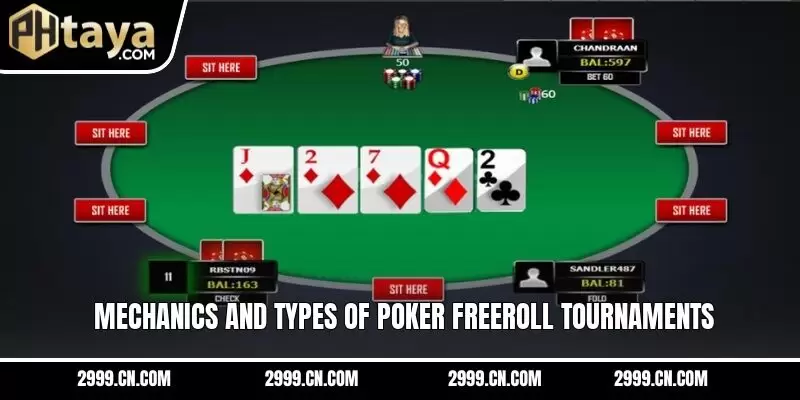
Mechanics and types of poker freeroll tournaments
While the entry fee is waived, the core mechanics of a poker freeroll closely resemble standard multi-table tournaments (MTTs). However, understanding the specific variations and buy-in options is crucial for resource allocation.
Standard tournament structure
Poker freeroll tournaments on PHTAYA operate on standard rules, but their structure often starts with very fast-rising blinds and deep starting stacks to encourage rapid eliminations.
- Starting Stack: Usually deep (e.g., 3,000 to 5,000 chips).
- Blinds: Increase rapidly (e.g., every 5 to 10 minutes) to pressure players into action.
- Prize Pool: Consists of cash, tournament tickets, or loyalty points provided entirely by PHTAYA.
Freeroll variants at PHTAYA
PHTAYA often offers different types of poker tournaments, each requiring a slightly different strategic approach:
- Standard Freeroll: Open to all registered players with zero requirements. The softest fields but the smallest prizes.
- Restricted Freeroll: Requires players to meet a minimal requirement (e.g., having made one prior deposit, or played a specific number of hands). These tournaments typically feature smaller fields and better prizes, making the competition slightly tougher but more valuable per player.
- Rebuy/Add-On Freeroll: While the initial entry is free, players may purchase extra chips (rebuy) if they lose their stack early, or purchase an additional amount of chips (add-on) at a specific stage (e.g., during the first hour). This small monetary investment significantly increases the prize pool and often weeds out the non-serious players.
Understanding the rebuy and add-on impact
Rebuy and add-on options fundamentally change the tactical play of a poker freeroll.
| Feature | Cost Implication | Strategic Impact |
| Rebuy Period | Requires a small fee (e.g., $1) for extra chips. | Encourages reckless, loose play early, as players know they can buy back in. |
| Add-On Break | Requires a small fee at the end of the rebuy period. | Essential for serious players; purchasing the add-on significantly increases chip value and EV. |
Serious players must budget for and purchase the Add-On in any poker freeroll where it is offered, as the monetary investment drastically increases the chip total and the prize pool’s worth.
Expert guide to mastering survival in every poker freeroll event
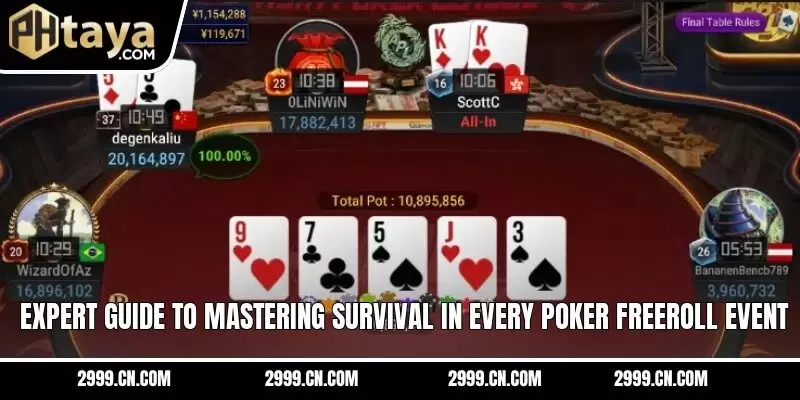
Expert guide to mastering survival in every poker freeroll event
Winning a poker freeroll is a marathon, not a sprint. The strategy must be adjusted significantly from standard cash games or high-buy-in tournaments to account for the unique, loose style of play common among the large field.
Adherence to strict positional discipline and timely aggression are the core tactical principles; applying these guidelines ensures you survive the volatile early stages and capitalize during the crucial bubble period of the freeroll.
Initial stage: Extreme tightness and discipline
The primary tactic for the first 30-60 minutes of a freeroll is extreme tightness. Since the entry is free, most players enter simply to gamble, playing virtually any two cards. Your goal is to patiently fold marginal hands and wait for premium hands (AA, KK, QQ, AK, AQ, strong suited connectors).
When you do enter a pot with a strong hand, bet heavily (3-4x the normal amount pre-flop) to isolate the pot and punish the loose callers. Patience here is your greatest asset against the chaos.
Mid stage: Positional aggression and stack management
Once the blinds become significant (mid-stage, after the rebuy period), the field size will have dramatically shrunk, and the play will become slightly more disciplined. Your focus must shift to positional aggression.
Start stealing blinds frequently from the late position (Button, Cutoff) and put pressure on medium stacks. Use your chip advantage to force weaker players to make difficult decisions, thereby accelerating their elimination from the poker tournament.
Navigating the critical prize bubble
The bubble phase the point just before the prize money is reached requires a complete reversal of play. Players with small and medium stacks become terrified of busting, making them incredibly tight.
Your tactic is to exploit this fear by relentlessly stealing the blinds and small pots. Aggressively raise against these tight players, but avoid confrontation with the largest chip leaders, who can afford to call your raises. This bully tactic is essential for maximizing chip acquisition without risking the tournament life during the poker bubble.
Bankroll building: Converting entry tickets
When successful in a poker freeroll, the prize may sometimes be a satellite ticket to a larger, paid tournament.
The strategic advice for bankroll building is to immediately sell this ticket value by using it in the tournament and playing a highly tight, high-discipline style to win the cash prize. This systematic conversion of risk-free tickets into tangible cash forms the foundation of a starting bankroll at PHTAYA.
Exploiting opponent tendencies (the call/fold mentality)
Recognize that the average poker player is often polarized into two extremes: the maniac who calls every bet, or the scared player who folds to any aggression. Your tactic must be tailored:
- Against Maniacs: Play only premium hands and bet strongly for value; do not bluff.
- Against Scared Players: Aggressively bluff and steal blinds frequently, as they will often fold anything but the absolute nuts.
Conclusion
Poker freeroll tournaments offer a perfect, unique, and risk-free opportunity to earn money, provided you strategically adapt your play to the loose, wild style common among the large fields. PHTAYA hosts verifiable, rewarding freerolls daily, providing the ideal ground for practice and profit.
 Air Combat 1942 – Unlock The Hidden Treasures Of The Sky
  Tantalizing Namaste Roulette – Experience Premium Gaming At PHTAYA
  Mighty Viking – Explore The Halls Of Glory On PHTAYA
  Golden Plunder – Join The Grand Treasure Hunt At PHTAYA
  Cai Shen Dao – The Ultimate Slot Adventure On PHTAYA
  Big Money Bass – Master The Best Pro Hacks At PHTAYA